
Should we use AI image generators to visualize the past?
dealing with the proliferation of fake history, pseudo-archaeology, and misleading science communication online

We are once again discussing the intersection of artificial intelligence and archaeology because writers on Substack and beyond are using AI to visualize new discoveries and illustrate their articles. There is nothing wrong with wanting to add color to our occasional grey-scale understanding of archaeological cultures, but how and why we do so matters. AI is also being used to generate images of excavations and “enhance” artifacts, which does not seem useful beyond making a “pretty” but inaccurate picture. Why not include photos of real excavations, is it not attractive or cool enough anymore? Should we be sacrificing accuracy for the engagement a flashy image could generate? Previously, I’ve written about AI’s threat to learning and higher education and how universities need to implement AI policies not only for coursework, but for master’s theses and Phd dissertations (see “AI can save time, but can it save you?”). Today, we’ll be interrogating the proliferation of AI “historical” and “archaeological” images and what someone should consider when viewing or creating this content.
While researching this article I had a perspective shifting realization: AI cannot see. It is recreating Stonehenge without ever seeing sarsen stones or holding a blade of grass between two fingers. This is obvious, of course, but as humans we instinctually want to personify and anthropomorphize, extending bodily sensation where there is none. These tools do not see and sense; they digest images as numbers and the more images its fed, the better it is at predicting how these numbers align with prompts.1 No wonder AI images are often uncanny and we can recognize them without being able to explain why. They are created by something without any senses, but sensation is the very basis of communication and art. If we do think of AI-models as operating like human brains, can a brain without a body create something good? Can it create something sensical?
Fake history and science miscommunication
Nano Banana users and the like may have good intentions behind their prompts and may consider image generation a useful tool for illustrating their articles or short-form posts. Nevertheless, if an AI image is not attributed to AI, the intentions of the account or author are dubious. A recent note from one of my favorite writers on Substack, María C.J, discussed how she struggled with differentiating between all the real and fake (AI) images teeming online.
“Sometimes I think if I, an art historian, cannot tell if images are real or not…what’s the chance of someone who hasn’t had any kind of visual culture training?”
Material culture is the main subject of archaeological study. Through multiple levels of visual, physical, and sometimes chemical analysis, and employing both art historic and scientific techniques, we can infer how an artifact was created and used. We then use the tangible, material evidence to extrapolate the social-cultural world they came from. Every minute physical detail of an object or a structure is an important line of evidence, but AI images tend to smudge the details and take some algorithmic liberties, where even enhancing an image of an archaeological site can obscure valuable context and information. I believe in accurate and transparent communication, especially since archaeology is often the subject of conspiracy theories and misinformation.
María’s quote above makes the worrisome point that fake images take advantage of people’s interests and lack of expertise— users enjoy fascinating images without knowing that the “archaeology” they’re seeing is make-believe. I do not think we should glamorize or fudge real images of archaeological sites to please the social media news feed or to mislead the public, it’s unethical.
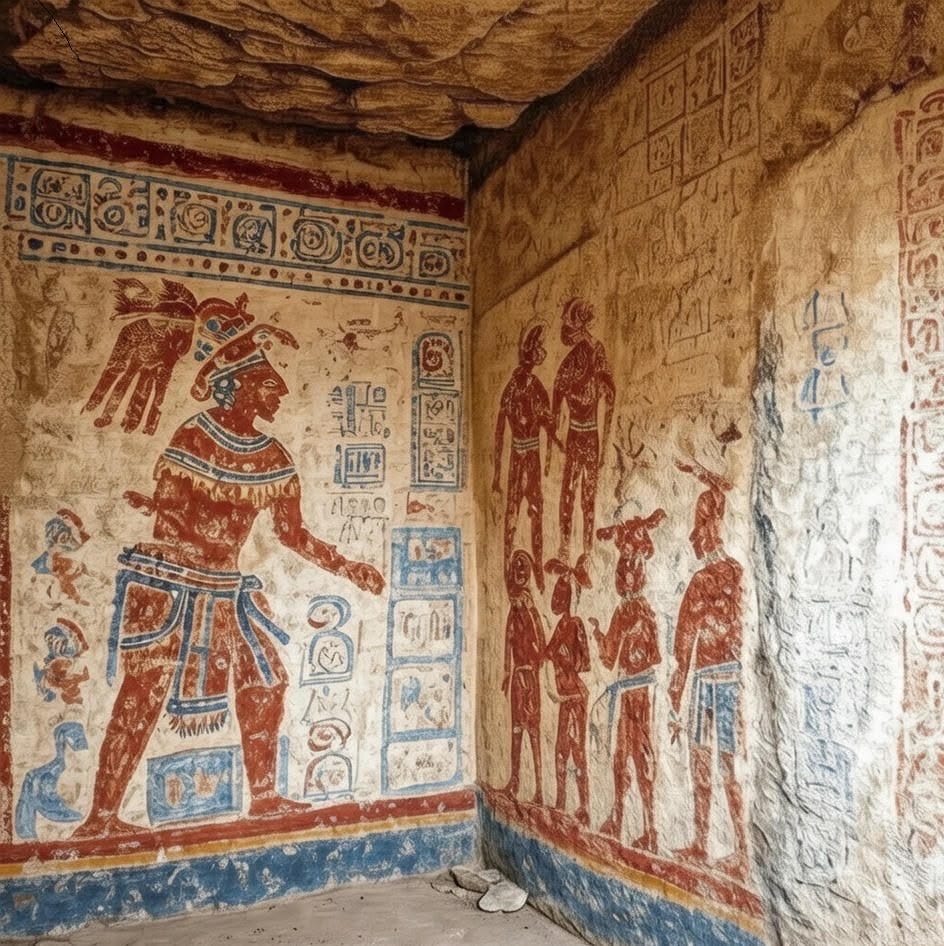
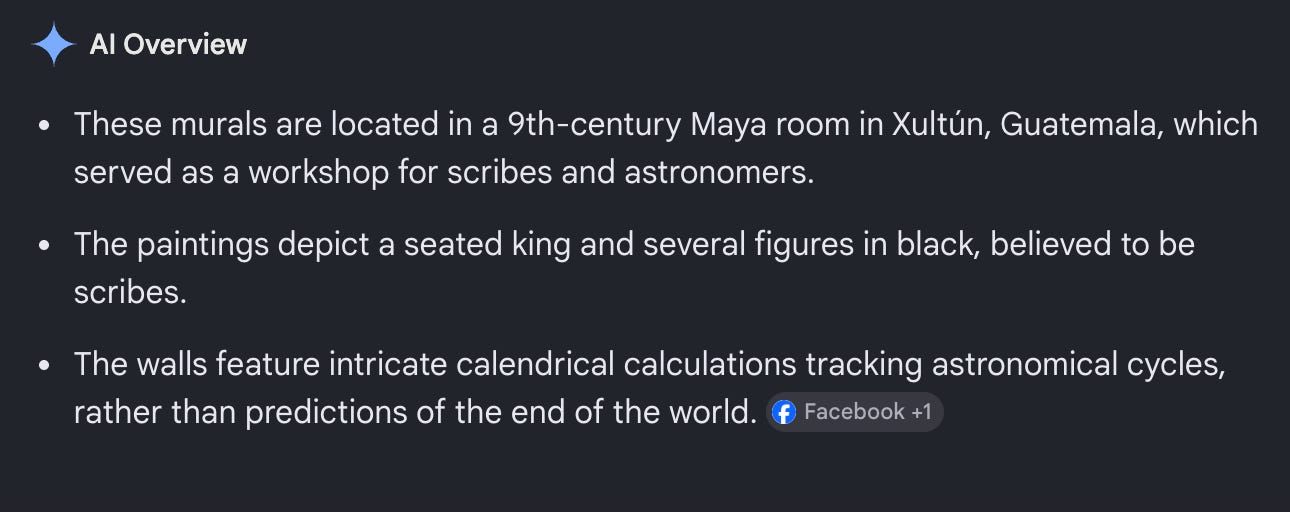
To address María’s note I did a reverse image search of the photo. The AI overview of the AI Mayan mural is a joke in itself and it fails to even accurately describe the image (though the real mural from Xultún does show black-painted scribes). The source is a Facebook post which was picked up by a few other accounts and reposted on Pinterest. One of the posts describes the mural as depicting a Mayan Queen named Ix Ch’ak Ch’een which was a discovery from an entirely different site, the Foundation Rock of Cobá, and published in Smithsonian Magazine last year.
A quick google search of either site will not yield the image above, because the image above is fake. One can hopefully identify the tell-tale signs: strange unidentifiable details, lack of actual Mayan glyphs, and a faux-painterly filter over the whole image. If you google the Xultún site, the results will bring you to the San Bartolo-Xultún Archaeological Project website which features murals that may have been used to prompt the AI-image. So everything about this is a nonsensical mess: the image, the description, and the reverse-image search results. This is why I am extremely skeptical of using AI to visualize the past; it very quickly becomes a misleading jumble communicating pseudoscience rather than real archaeological work. Much like an optical illusion, these uncanny, unrecognizable forms create a semi-coherent image when zoomed out and skimmed over. (Though of course, these models are getting better by the second and when no one can tell the difference anymore, images will lose their 1,000 words value).
Fake images and photoshop have been circulating the internet since long before AI, often proliferated by pseudoscientists and social media accounts that profit off of sensationalizing the past. AI-image generators have just given grifters a shiny new tool to feed the Ancient Aliens/Ancient Apocalypse rhetoric. If you google “AI image of Stonehenge construction” about half of the results are of aliens or fantastical creatures doing the work. (For an entertaining debunking of both Ancient Aliens and Apocalypse, check out Milo Rossi’s youtube videos on the topics). What are the intentions of these “science” and “history” accounts that use AI to enhance or completely falsify archaeological discoveries? I do not think it is to communicate anything with accuracy or nuance, my shocking hunch is that these accounts do it for views and clicks! If the intentions behind an AI image seem dubious and self-interested, I would not trust the information being communicated. Would you trust a scholarly paper with no author, no sources, no peer-review, and blatant conflicts of interest?
The flawed tool
I was going to discuss the “good, bad, and ugly” (how clever!) of AI image generation, but the structure of this article has taken a turn. There was little good to be found, and both the bad and the ugly come from the core of the tool itself. Images are scraped from the internet of real people, places, art, and a whole lot of stock photos. Images from media, movies, games and art are baked in with the real and historical. Does the tool know the difference between a real photograph and a still from a science fiction movie? Is there any difference between the factual and the fictional in the world of AI? Not really, because it only knows the world through two-dimensional media rendered in pixels and numbers. It’s a database of entirely secondary and tertiary sources. The distinction between the factual and the fictional, however, is crucial for creating accurate representations of archaeological sites and situations; but space, perspective, and physics, are also limited in AI’s virtual-world. Furthermore, databases are only as good as the data they contain; it is no surprise that biases and cultural stereotypes are reproduced and amplified by AI tools. While limitations and biases are addressed in scientific research, the AI-user tends to embrace them with open arms. The tool is wielded without discretion, but with authority, which again leads to poor science and history communication. Ultimately, AI image generators are not reflecting tangible reality, but a mirror reflecting another mirror and casting egregious distortions.
One of my major concerns with AI image generation is how these tools are used to render people. AI images of archaeological cultures often depict beautiful figures with symmetrical faces, European standards of beauty, and anachronistic clothes. The result is often a “yassified” version of history. Google “AI image of Aztec/Etruscan/Insert-culture-here” and you are guaranteed results of hot (pornified) women (but let’s not get into the gender politics of it all). Archaeologists should not be speculating about the physical attractiveness of their research subjects, but using AI image generation rather than reconstruction artists will yield these biased results. These images are not rendered by the tool to be accurate or thoughtful, but to please the user. This begs the question, does using AI to render historical figures or archaeological discoveries really humanize the past, or are we just jumbling scientific research with our own slop? Are these tools just filtering the past through our own biases, prejudices, and desire for pleasure and entertainment over accurate reality?2
Archeologist-influencer Miniminute Man (Milo Rossi) made a video on the Lake Waccamaw canoe from North Carolina that demonstrates the current state of affairs.3 The intersection of AI-image generation and archaeology is rife with stereotypes and historical inaccuracy. The real images of an 1,000 year old dugout canoe was not interesting, not “Indian” enough for what I believe are predatory, fake history accounts on social media. The 28-foot long dugout is mutated and disfigured into a painted mobile tipi. The artifact is associated with the Waccamaw tribe of North Carolina, while tipis are culturally specific to Plains tribes in the Western United States. The whole thing is inaccurate and nonsensical, only communicating racial stereotypes to attract views. Some of the AI-renditions show construction crews lifting an equally inaccurate canoe out of the water or depict the ancestral Waccamaw Siouan people, in stereotypical Plains garb, carving the canoe. It is not clear where the original tipi-canoe image came from, but it has been reposted on every platform, including Linkedin, to the admiring comments of viewers who believe that it is somehow representing a dugout carved from a single tree.
![A Native American 28-foot canoe estimated to be 1,000 years old was recovered last week from southeastern North Carolina's Lake Waccamaw [1280x1753] : r/ArtefactPorn](https://substackcdn.com/image/fetch/$s_!trU7!,f_auto,q_auto:good,fl_progressive:steep/https%3A%2F%2Fsubstack-post-media.s3.amazonaws.com%2Fpublic%2Fimages%2F8d54cb28-bf8a-424d-bf93-7d8fb820e7ba_1280x1753.jpeg "A Native American 28-foot canoe estimated to be 1,000 years old was recovered last week from southeastern North Carolina's Lake Waccamaw [1280x1753] : r/ArtefactPorn")
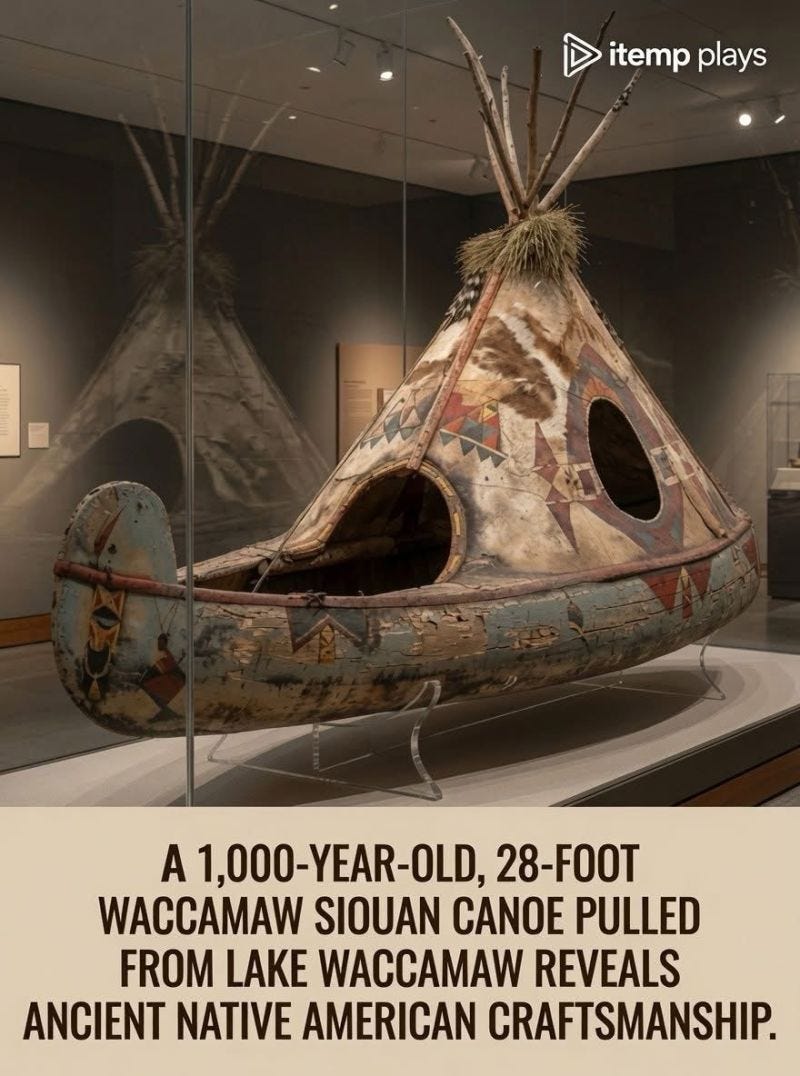
You’ll notice as you sift through this type of content that AI images and their descriptions do not add up and rely on the naivety of the viewer and the attractiveness of the image to be accepted. The tipi-canoe is clearly not a historic dugout carved from a single tree, nor is the Mayan mural from Xultún depicting a Queen from Cobá. Even if you struggle with recognizing AI visually, paying closer attention to the description of these images can help one recognize that they are fake. The reverse image search of the tipi-canoe states: “some observers have noted that the tipi structure seen inside the canoe in this specific image is inaccurate for this type of vessel and likely represents a computer-generated anomaly.”
A computer-generated anomaly… or someone egging on an AI image generator to make a canoe “look more Indian.” These tools are not being used to accurately and thoughtfully visualize the past, but to visualize and perpetuate modern biases and stereotypes. Once the image is made and proliferated the more effort and intentionality it takes to disentangle fact from fiction. As media literacy wanes, the more insidious and effective AI images become at misrepresenting archaeology and our world at large. Uncanny images with no source, no attributions, and many a slop-account reposts are likely AI and we MUST advocate for the labeling of AI content across platforms. Without transparency, the internet will become a dead zone where no images or individuals can be trusted or even tied to real people. (Which is already happening, i.e. dead internet theory).
With good intentions and discretion, should we use AI to visualize the past?
My concern is that even with the best intentions and expert knowledge, these tools will err on the side of inaccurate. Visually, I find real photographs or human-made illustrations more appealing, and of course more accurate, than anything an AI image generator could cook up. Since the overwhelming majority of historical AI images are created by dubious social media accounts, often with bad intentions, I think it would better serve a history/archaeology writer to distance themselves from this type of media. Though these images may attract viewers and drive engagement, they do not promote a deeper understanding of history or archaeological sciences, nor do they inspire trust from the luddite-leaning reader. Personally, I am skeptical of writers who use AI images since in our sphere of the internet (and many others) this tool is often used to mislead.
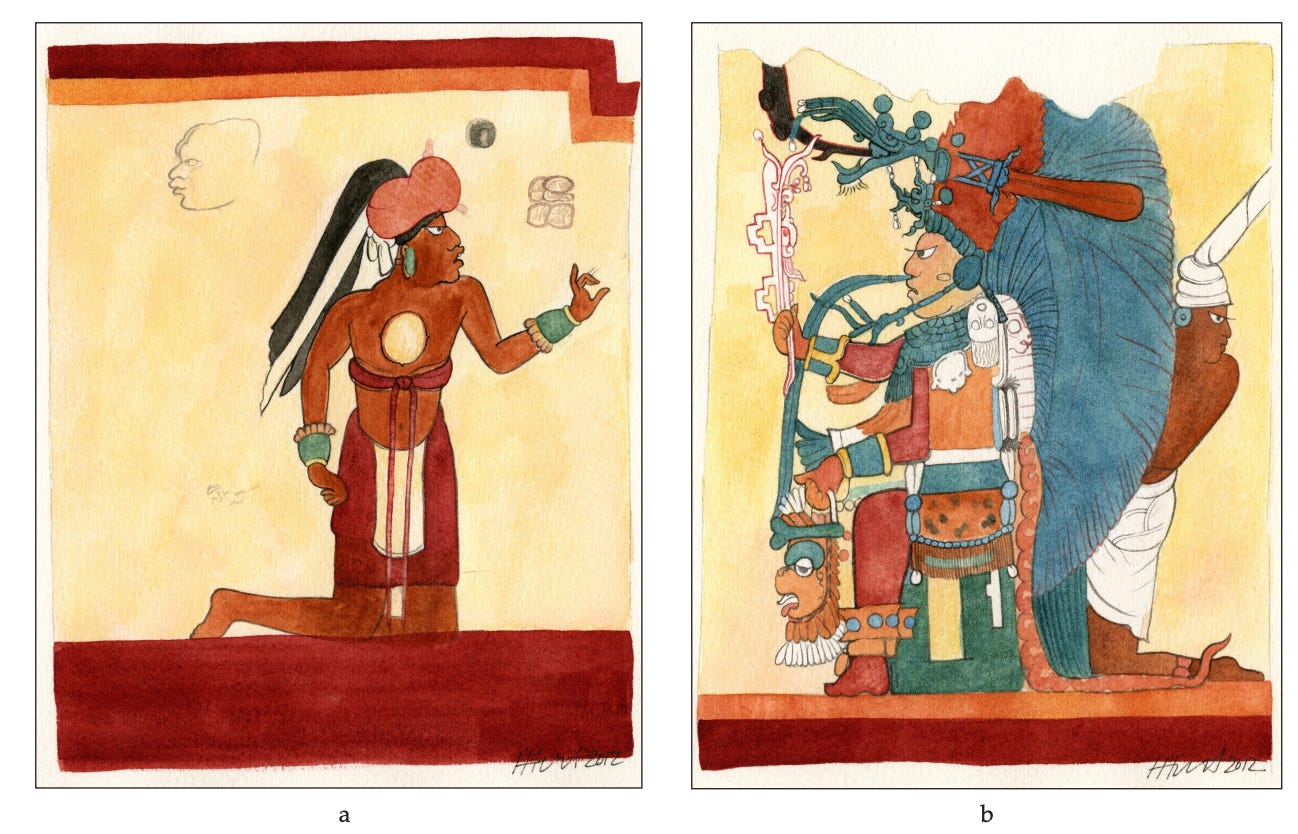
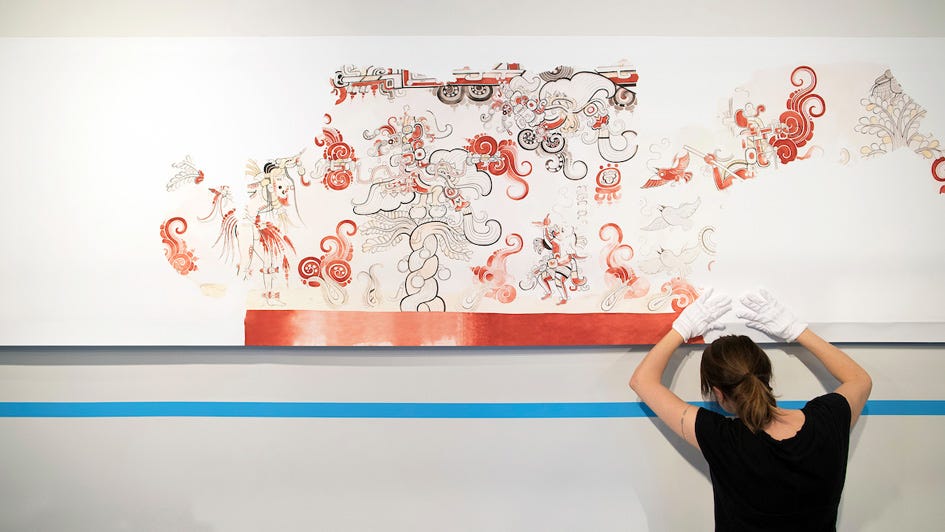
Fortunately, there are artists who specialize in illustrating the past. The difference between real artists and AI tools is accuracy and transparency. Artists who specialize in reconstruction drawings are often trained archaeologists themselves or work directly with experts. Whether computer-generated, pencil drawn, or water color, these images are clearly reconstructions made by real people. The viewer will know they are looking at a well-informed interpretation directly attributed to an artist. In many contexts, real hand-drawings are required to record rock art or murals that a photograph cannot completely capture. It is still standard practice that petroglyphs and pictographs are hand-drawn by archaeologists in the field (at least in my neck of the woods). In the real Xultún tomb, the archaeological illustrator Heather Hurst was immediately called in to draw the mural herself.4 Artistic skills are incredibly valuable and still required by our field5 , and my own artifact illustrations will be published in a monograph soon.
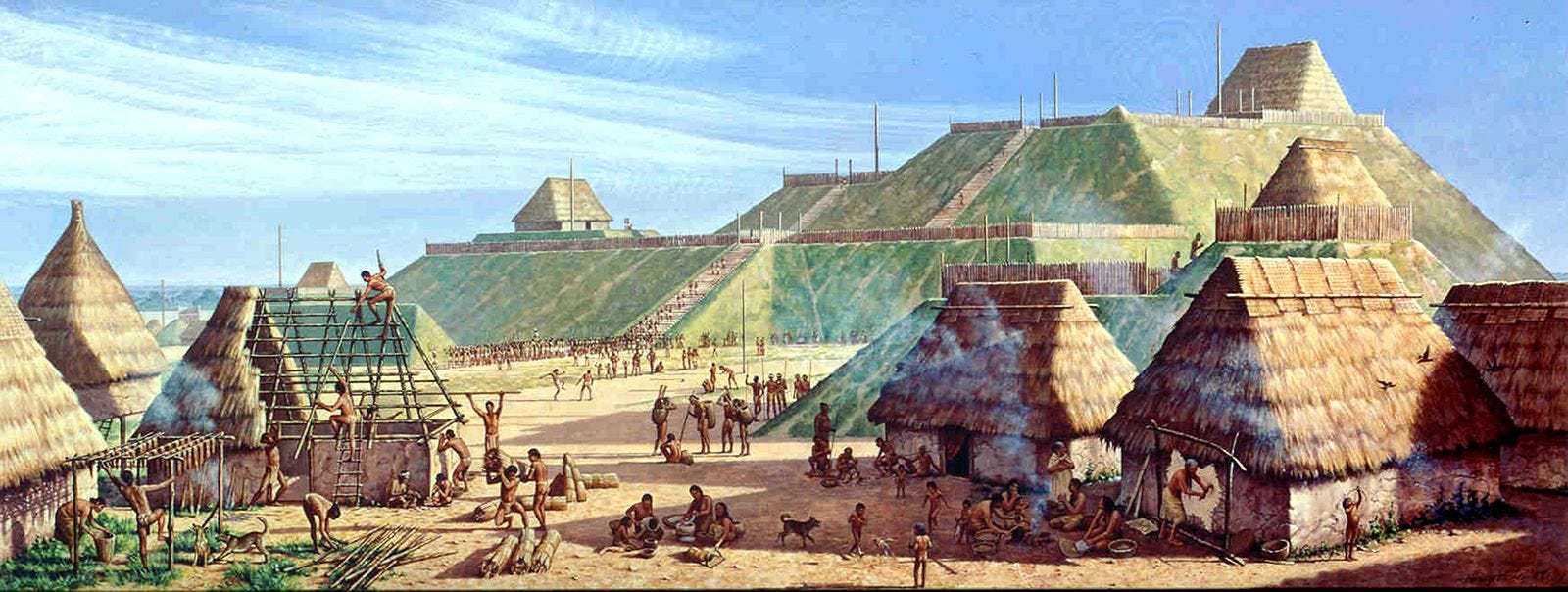
Reconstructions bring archaeology to life, helping a wide audience visualise and understand the archaeological remains. We offer a pioneering service in this area; our artists work closely with our specialists to accurately visualise past communities and landscapes based on the archaeology and environmental evidence we discover on site.
“Reconstruction and Visualisation” from Wessex Archaeology
Overall, I am skeptical of AI tools and the soulless, echo-chamber culture we are barreling towards. Whether its generating visual art or writing, I do not see any value in taking the humanity out of the creative process and off-loading the communication of emotions, senses, and experiences to a predictive model that can neither see nor feel. In our current image-driven media economy where images are rapidly torn out of context, it is more important than ever to cite sources and clarify where our art and images come from. Even though we are playing at science communication on social media, we should hold ourselves to the standards and ethics of our discipline (whatever that discipline may be). I may not be following the Chicago Author-Date style because I maxed out on that in grad school, but I am nevertheless citing my sources so you can access the same information as me.6 We need accurate science communication written by real people for real people, because pretty soon the internet is just going to be AI-bots advertising to each other. A picture may represent 1,000 words, but I don’t think looking at an image can replace the understanding that comes from reading (or listening) to an 1,000 word article. An artifact in a museum without context and description may be beautiful, but it will be impossible to interpret and understand; visualizing the past then becomes meaningless. Aesthetics alone are not what give archaeology value.
As always, thank you for reading Archaeolog. If you want to support my work beyond liking and commenting, consider subscribing or sending a one-time donation to my Kofi.
I probably shouldn’t use words like “digest” but again, its hard to avoid.
All reconstructions are filtered through our modern eyes at the end of the day. I actually find how our perception of the past changes overtime very interesting— how the 1970’s visualized the medieval or how the 2000s visualized the 70’s. Our interpretations of the past will always have biases, which is why the intentions and methods behind illustrating/reconstructing history are important.
https://www.smithsonianmag.com/smart-news/this-dugout-canoe-made-from-a-12-foot-long-log-was-found-bobbing-in-a-north-carolina-river-180986898/
https://www.xultun.org/videos/v/the-murals-of-san-bartolo
https://www.mesoweb.com/reports/Xultun.pdf
Learn more about reconstruction art from Wessex Archaeology
Though I am being a bit lazier here just giving you a footnote and a link but… we’re not really citing scholarly sources in this!
I have been thinking about this for days, too. I don't want to fall into conspiracy theories, but I can't fail to notice that the rise of AI is parallel to the massive defunding of the humanities worldwide, and the constant discourse that it is useless knowledge.
I didn't realize the 'Xultún mural' was fake because I realized the background was AI generated, as most people pointed to, but because I am an art historian and I have a vast visual archive always running in the back of my mind. I noticed the mural wasn't real because I've seen many Mayan murals and I could tell those weren't it. It is a kind of pattern recognition--when you've seen enough examples of a particular artistic style or historical period, you learn to recognize it, and therefore you can tell if something doesn't belong in that category.
We're constantly telling people 'how to recognize AI images', analyzing the texture and look of the images, but, what if people knew enough about visual culture to realize monuments, artworks or archeological pieces in AI generated images were not real because they know the ones that ARE real? Who is benefitting from people being ignorant of what images are real and which ones are fake? Is there anyone out there who prefer people not to have any kind of visual literacy for their AI, algorithm or social media business?
Often these images are scrutinized by readers for meaning—for educational purposes, to see and know the world more intimately. Imo, the best that can be done for the audience is to help cultivate a reader's internal concept of objects and histories as accurately as possible. Each detail of an image, from choice of media to qualities of mark-making and symbolic representation to the reflection of light from a surface, has consequences for that narrative.