
What is California "Mission" Basketry?
Indigenizing mission art through the work of Gabrieleño/Tongva scholar Yve Chavez

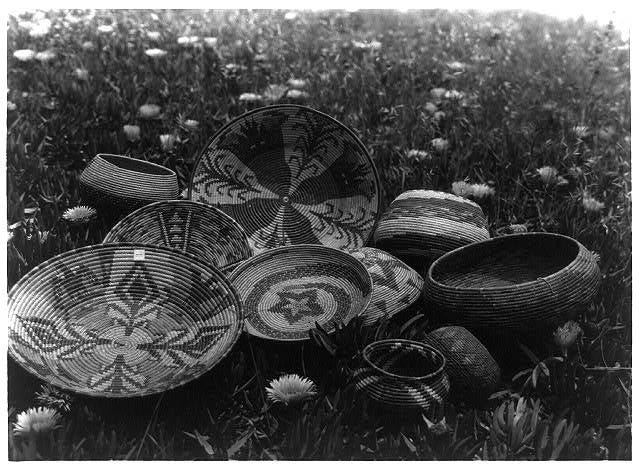
Graduation is just around the corner and burnout is still hunting me down. I have not been able to focus on tangential research for this publication, but I thought I could adapt some of my academic writing into a post. The Cultural Background section of my thesis, one of the most impactful and fascinating portions of my thesis to write, explores the label of “Mission” basketry and the value of Native perspectives in art history. My master’s thesis was a bit of an experiment with pXRF (portable X-ray fluorescence) technology and woven basketry to analyze a basket collection undergoing repatriation1. pXRF is a method of elemental and/or chemical analysis which uses X-rays to excite atoms in a sample and measure their elemental energies, creating wavy spectra that illustrate the elemental composition of the sample (click the links to check out previous posts on pXRF and my thesis). This project was a cross-institutional collaboration between my university, a county museum, and multiple Native American tribes. I am ever-grateful for having the opportunity to conduct this research and learn so much about Southern California basketry, historic museum practices, and pXRF technology. Since I had the freedom to dive into whatever background topics I saw fit, I made sure to situate the basketry collection we worked with in the context of Native Southern California history and weaving traditions.
For a bit of context, basket weaving traditions extend far into the past and some of the most ancient fiber technology in the Americas has been found in California, dating to the early Holocene.2 Local resources and environments shaped basketry traditions, and weavers shaped plant ecology by tending, pruning, burning, and cultivating fiber plants. In fact, many basketry plants must be tended in order to produce fibers of ideal size and length for weaving. Tending the Wild by M. Kat Anderson (a must read!) examines how interconnected basketry traditions are with land management practices and plant cultivation. Generally, baskets were constructed for everyday use such as food storage, processing, and cooking. However, baskets also served ceremonial and ritual functions and were used for storing valuable items like shell beads. Weaving traditions were as diverse as the 100+ tribes in California, and individual weavers developed their own idiosyncratic designs as well. Coiled basketry is a tedious, long-term process that requires expert skill for stitching tight weaves and mapping designs into three-dimensional space. The basketry traditions of Southern California (specifically in the Santa Barbara, Los Angeles, San Bernardino, and San Diego regions) are often lumped together as “Mission-style,” in reference to the Spanish Missions (1769-1834) where many tribes in the region were evangelized (forced assimilation) and forced to work to support Spanish settlements. As I described in a note from the other day, Euro-American collectors at the turn of the 20th century liked the idea of purchasing baskets from Mission survivors and descendants, perpetuating both the “Mission fantasy” and the “vanishing Indian” narratives of the time. Eminent anthropologist (though very controversial today), Alfred Kroeber, formally defined the “Mission-style” in 1922, effectively collapsing different tribes and time periods together and centering European influence on Native art. Recent scholarship has sought to reassess and reconsider the label of “Mission” art.
Reconsidering the Mission Era: 1769-1834

Yve Chavez describes missions as sites that are “deeply misunderstood, vilified, and romanticized” (2025: xiv).
Alta California was first encountered by Europeans during Cabrillo’s 1542 expedition to connect New Spain to Southeast Asia. Traveling north up the coast, Cabrillo met the Kumeyaay in San Diego, the Gabrieleño on Catalina Island, and various Chumash communities in Santa Barbara and San Luis Obispo. Foul weather at Monterey Bay forced the San Salvador to return south, and Cabrillo died on Catalina Island where the crew took shelter for the winter. Though the expedition was considered unsuccessful at the time, it inspired European interest in Alta California and sparked numerous European voyages along the coast— Sir Francis Drake (on his way to circumnavigate the globe), Sebastian Rodriguez Cermeño (who mapped the coastline), and Sebastian Vizcaino (who urged the King of Spain to colonize the region). However, it would be another 166 years until the establishment of Spanish Missions in Alta California.
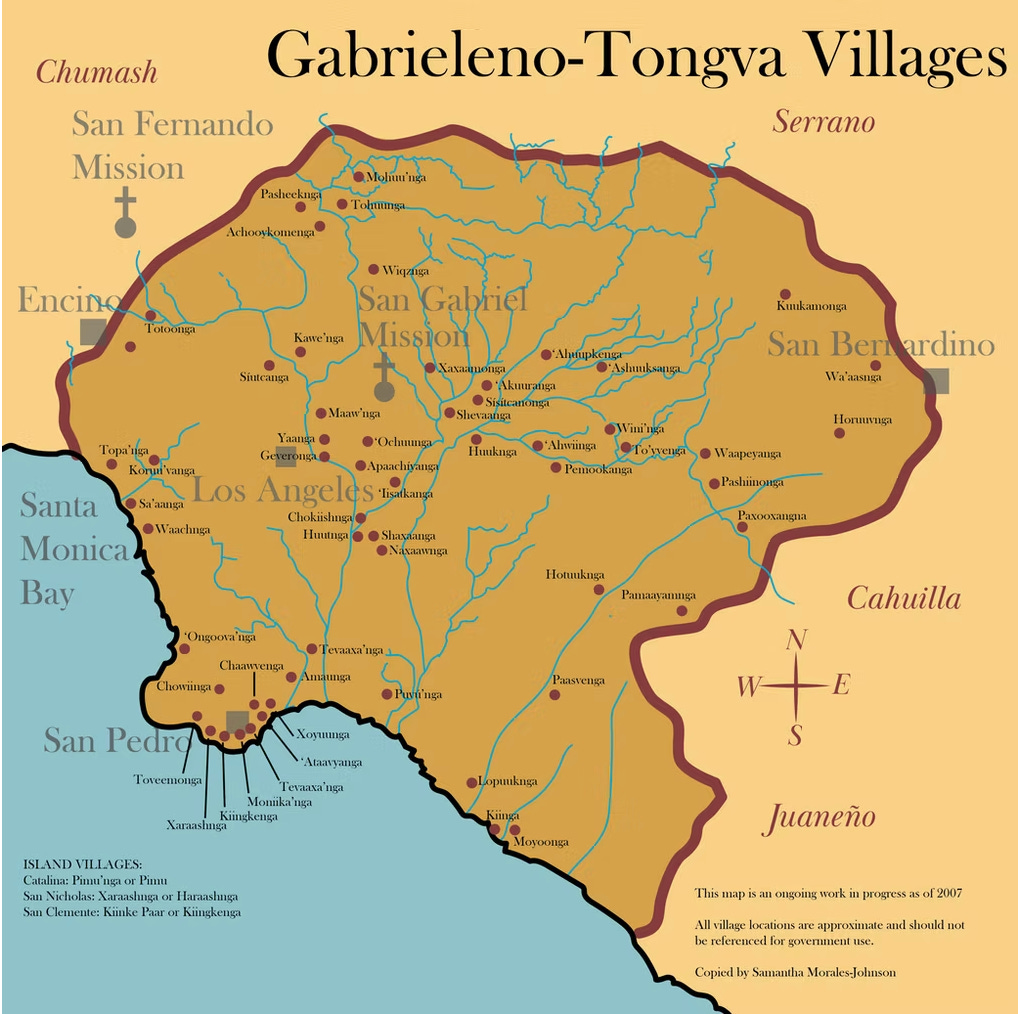
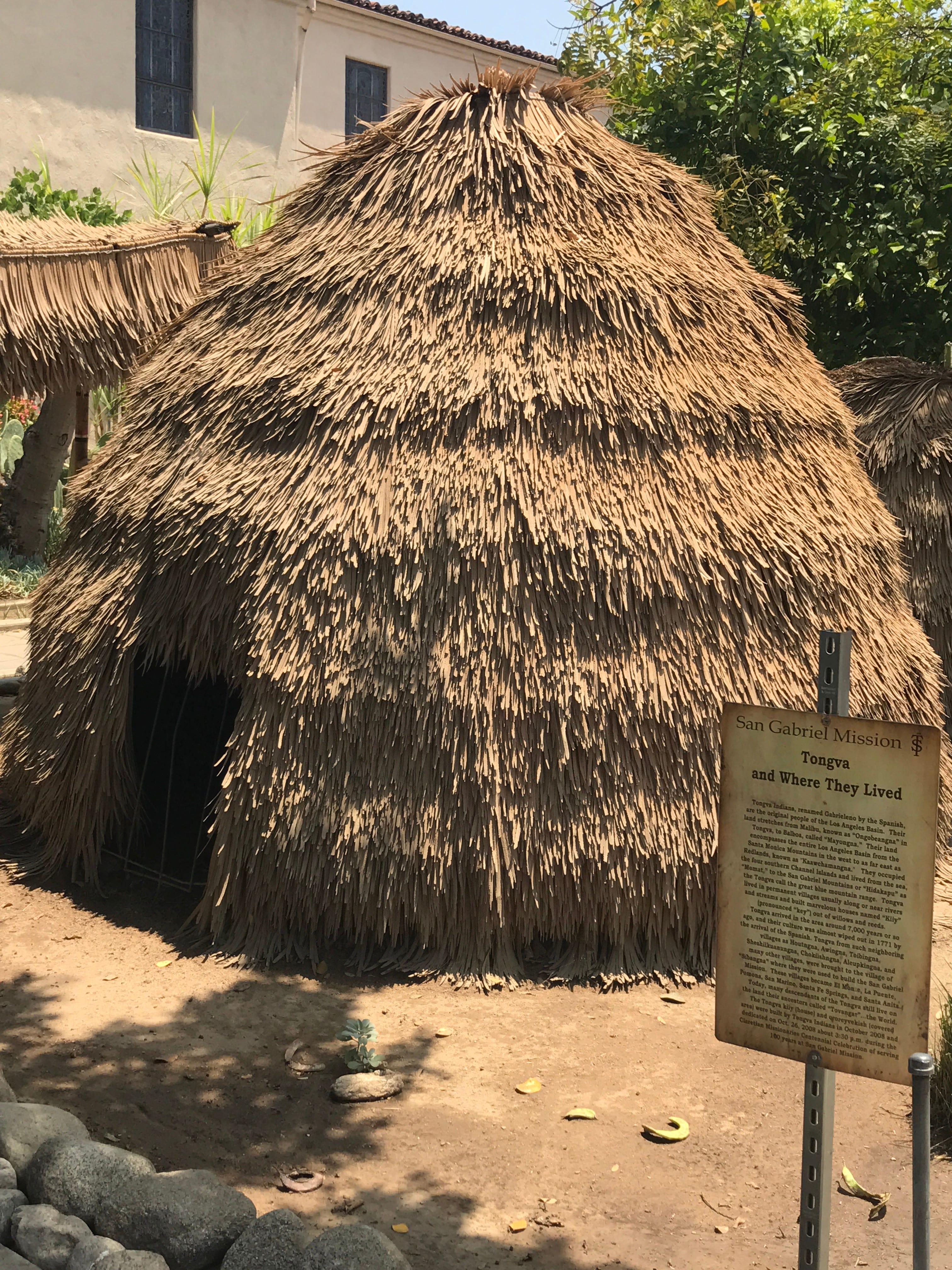
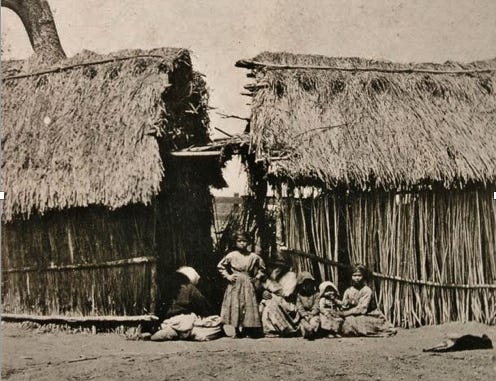
Expanding on the preexisting mission system in Baja California, Junípero Serra and Captain Gaspar de Portola voyaged north to establish missions from San Diego to Sonoma.3 Spanish Franciscans established missions and military outposts (presidios) which relied on the exploitation of Native laborers and resources. Missions also relied on military support to forcibly relocate and control communities. Initial settlements consisted of ephemeral structures of wood, willow, and tule, built with the assistance of Native peoples. Eager to evangelize the Gabrieleño (also known as Tongva) peoples, the first structure erected at Mission San Gabriel was the church; however, the open-air, tule-walled construction was closer to Gabrieleño oroyvekish than a Spanish church. The original site was established in a village called Hutukngna, demonstrating how Missions were built directly out of Native communities employing local culturally significant materials.
With limited imports of European materials, Spanish architecture styles needed to be reinterpreted through locally available resources. The Native-style temporary structures were eventually replaced with adobe, then kiln-fired brick and white-washed stone we associate with mission churches today. Gabrieleño/Tongva art historian Yve Chavez describes how Native and Spanish architecture reflect the different world-views of these colliding cultures; Native tule and willow structures reflect a connection and extension of the natural landscape, while the Spanish preference for monumental stone architecture represents human domination over the natural world. 4
While the goal of the Spanish government and the Catholic Church was to ostensibly save the souls of indigenous Californians, missions established an economic system that could support Spanish colonization of the region. One of the European explorers, Vizcaino, urged the King of Spain to colonize California because of both its natural resources and its “built-in” workforce. Though paid on the outset, by the turn of the 19th century the Church stopped compensating Native laborers while also selling Native-made art to supplement dwindling budgets. Pueblos, the first civilian settlements, cropped up around missions such as the pueblo de La Reina de Los Angeles in 1781, which was actually built out of a Gabrieleño village. The general Angelino sentiment today is that Native California history is separate from the history of LA— the connection seems ancient and tenuous.5 But in reality, the first iteration of the the city I call home was hand-built by Gabrieleño people.
The sordid history of Spanish missions is often sanitized in public education and at mission museums, which of course want to maintain an attractive narrative to support tourism. The assimilation process, or “missionization,” resulted in a drastic decline in Native populations who were forced off their lands, intentionally overworked, severed from traditional practices, and subjected to violence and torture (as well as massacres). Unmarried women were kept in monjeríos, chaperoned dormitories, where their relationships with men could be monitored by the church. These features of mission settlements are often excluded from historic narratives at mission sites today, and the location of the original monjerío at Mission San Gabriel was not recorded. Social reorganization broke down traditional familial and social structures and padres assumed reproductive control over the community (controlling who women married and the conditions those children were raised in). Mission records of Native converts and laborers often showed diminishing populations due to disease and oppressive conditions— resulting in an estimated 72% population loss.6 Despite the sanitization of mission history by the Catholic church, many anthropologists re-characterized missions as prisons and monuments to colonialism; but, as Yve Chavez explains, it is much more complicated than that.
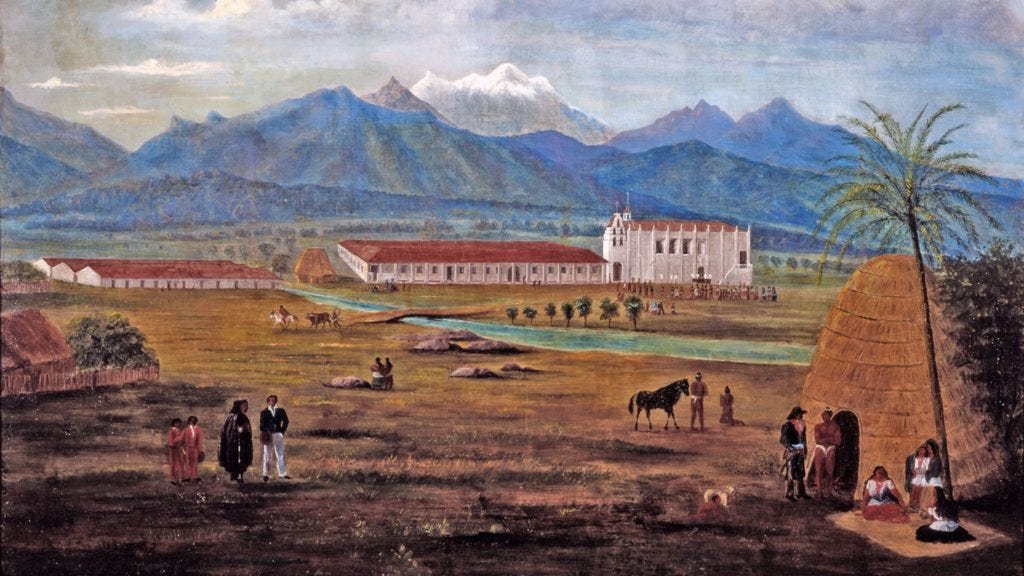
In her recent publication, Indigenizing California Mission Art and Architecture, Chavez describes missions as sites that are “deeply misunderstood, vilified, and romanticized” (2025: xiv). Native identities were not only tied to tribes but distinct villages, and as communities were brought together in Spanish missions, identities merged and shifted. Some of the descendants of Mission San Gabriel in present day Los Angeles identify as Gabrieleño, and since non-federally recognized tribes do not have reservations, the mission is a physical place where the living community can connect with their ancestors. As previously stated, Native peoples hand-built and supported mission settlements and their influence on mission art and architecture is often understudied and undervalued. As Chavez states, Mission San Gabriel is the place where her community “mourned, celebrated, and survived” (2025: xiv).
Recent scholarship on Native persistence and resilience challenge the metaphor of “missions as prisons” which severed Native people from their land, history, and culture. Documentary and archaeological evidence demonstrate how Native Californians mitigated and resisted European influence, maintained trade networks, continued hunting and foraging to supplement diets, and took paseos to leave the missions. And of course, Native communities actively resisted the mission system by meeting the Spanish military with force and organizing rebellions— when friars banned traditional dancing, the Gabrieleño fought back with the support of local village chiefs.7 Archaeologists Tsim Schneider and Lee Panich stress that terminal narratives of cultural discontinuity should be replaced with diachronic narratives of cultural persistence. The enduring tradition of basket weaving reminds us that colonization was just one chapter in the full timescale of Native history, and one of the many examples of how Native traditions adapted, transformed, and persisted to the present day (2020: 105).8
Indigenizing “Mission-style” Basketry
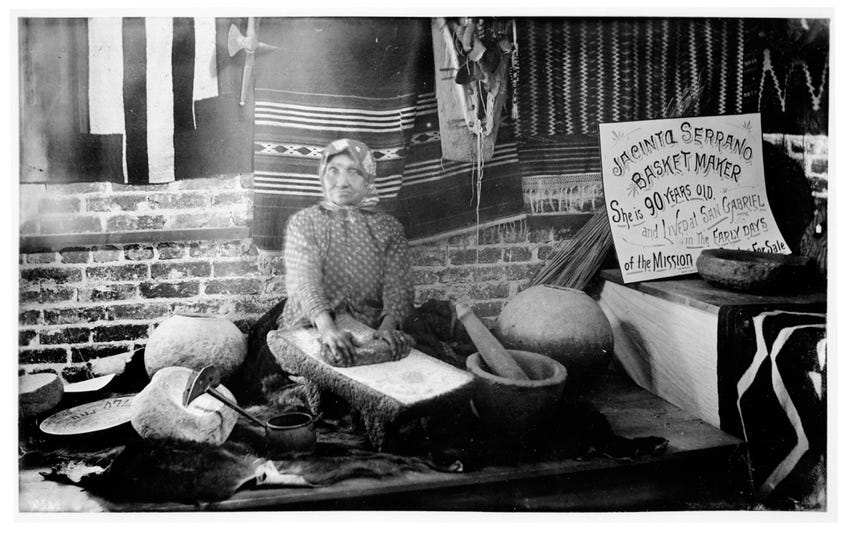
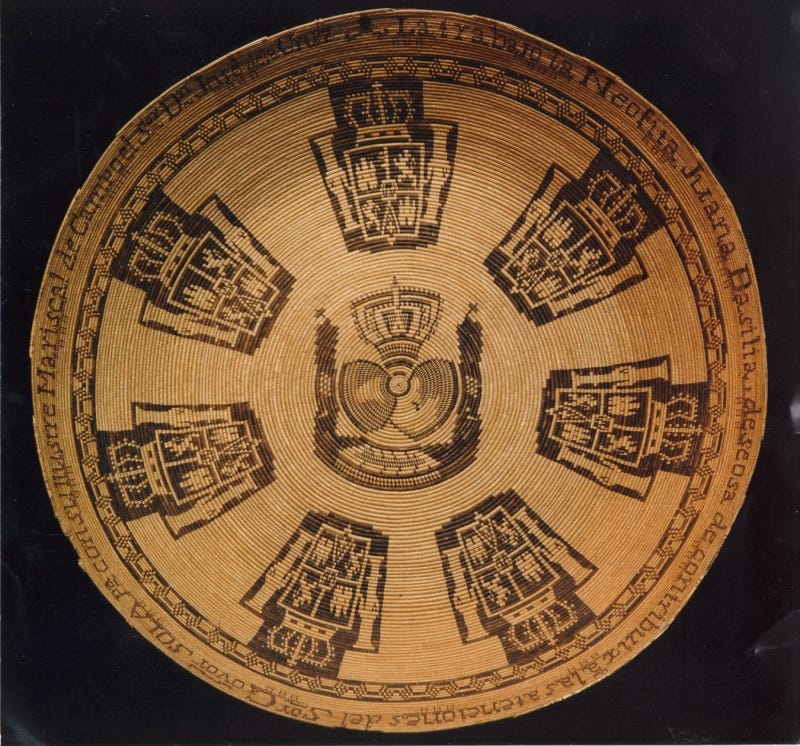
Basketry traditions are an example of Native Californians negotiating the “constraints and opportunities of colonialism” and continuing cultural practices through the Mission era (Panich 2013: 105).9 Early accounts of European-Native contact record that fine woven baskets were offered as gifts from tribes to visitors. Fray Juan Crespí described receiving “gorgeous and very elegant rushen baskets and bowls worthy of the admiration of any person with good taste” (Chavez 2025: 50). Native peoples continued weaving baskets and using ground-stone tools for everyday use, as well as maintaining ceremonial practices (such as Chumash dances and Gabrieleño Wind Sycamore ceremonies).10 As European settlers and traders became interested in Native art, weavers constructed baskets not only for domestic and ritual use, but for the beginnings of a commercial market. During the Mission era, Chumash weavers made large “presentation” baskets with heraldic imagery, designs from Spanish pesos, and lettering such as the name of the weaver herself (see image below). Padres allowed women time off from other duties to focus on their craft, trading and exporting baskets alongside other Native-made goods to financially support missions (Chavez 2025: 63-64).
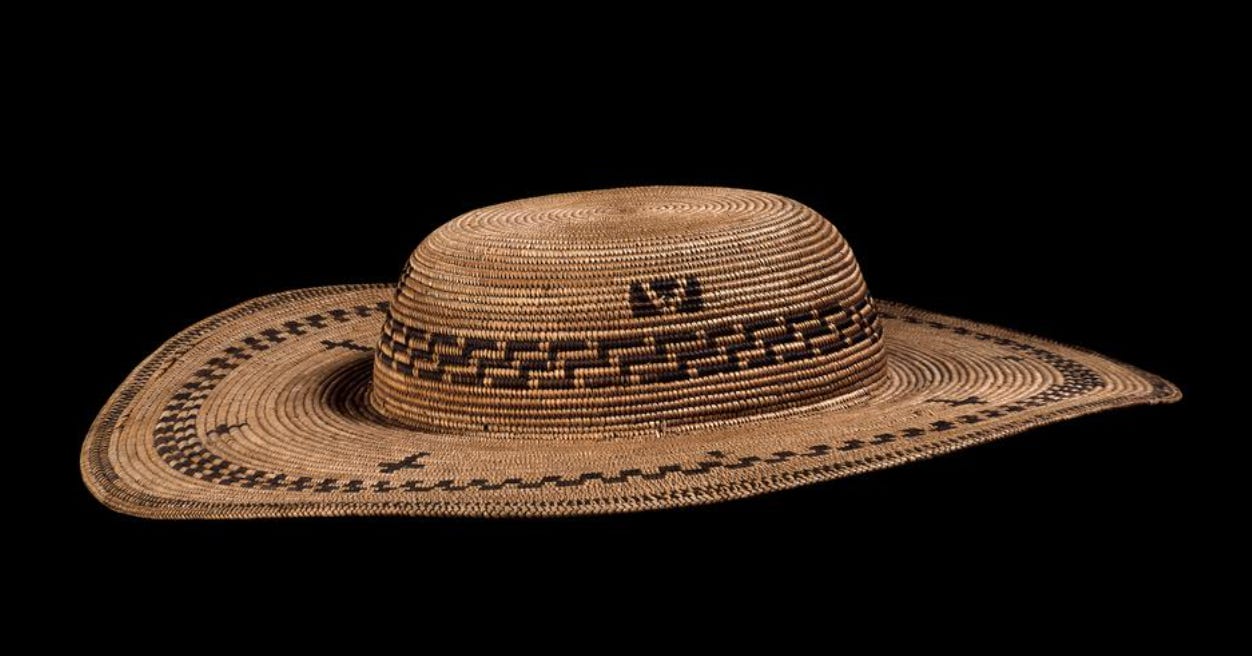
Basketry traditions are dynamic; it is no surprise that Native weavers interpreted and incorporated European designs and forms into their work. Woven objects took on new forms such as the one-of-a-kind sombrero hat made by Chumash weaver in the 1790s (image below). Representing the breadth of cultural exchange at the time, the wide-brim form is reminiscent of Filipino salakot style hat which would have been imported from the new Spanish colony. When the Mexican government broke down the mission system in the 1830s, a process known as secularization, Southern California weavers continued crafting baskets to sell to Euro-Americans. Baskets were made smaller, finer, and in different forms modeled after European dish ware. The “basket craze” reached its peak in the 1880s and lasted into the 1920s, resulting in the trade of Native California art across the world and the formation of many private and museum collections. Native art collectors were inspired by the “perceived embodiment of desirable cultural values such as naturalness, primitiveness, and simplicity” (Smith-Ferri 1998: 69), as well as narratives of cultural decline— if they did not collect baskets soon, the art, like their creators, would be gone.11
Yve Chavez reassess the “Mission” basket style in her thesis and subsequent book, Indigenizing California Mission Art and Architecture. With basketry art dating back at least hundreds of years, Chavez seeks to separate post-contact basketry from pre-contact basketry, as well as separate post-mission basketry from baskets made during the Spanish mission era between 1769-1834. The “Mission” designation was defined by Alfred Kroeber in his 1922 publication for the American Museum of Natural History. Though there were 21 Spanish Missions throughout northern and southern California, Kroeber’s “Mission style” only includes baskets made by Southern California Tribes— Chumash, Gabrielino (Tongva), Fernandeño, Mountain, Pass, and Desert Cahuilla, Juaneño, Luiseño, Cupeño, Northern and Southern Diegueño, and Serrano. Kroeber attached the term “Mission” to baskets made before the establishment of Missions pre-1769 and post-1834, and included baskets made by weavers living outside of mission settlements. According to Chavez, Kroeber’s designation blurs the lines between traditional and post-colonial basketry and ignored tribal differences. Furthermore, the names of individual weavers were seldom recorded or considered artists at the time. Chavez stresses that baskets should be identified by tribal affiliation if possible and analyzed within the historical and cultural context in which they were created.12
Kroeber described some Native California basketry traditions as the finest in the world, but his analysis of Southern California basketry is more critical (1922). In his brief publication, Basket Designs of The Mission Indians of California, Kroeber primarily analyzed the physical characteristics of baskets and design elements, focusing on “irregular” baskets and “unbalanced” designs which he cites as being caused by “indifference [rather] than incompetence” (1922: 173). Following the conventions of the burgeoning field of anthropology, Kroeber described visual motifs and designs in western terms without discussing what they may have represented to the weaver or her culture and community (1922: 163-172). The absence of cultural background on basketry construction and design is because this publication was an analysis of museum collections which did not include ethnographic research or interviews with actual weavers.13 As anthropological analysis has developed, so have our interpretations and understanding of Native basketry; recent analyses by Chavez and Moser respectively consider historically overlooked factors to describe basketry construction and design. This theoretical development in basketry studies demonstrate how indigenous or emic perspectives are essential for analyzing basketry as art.
Chavez analyzes “Mission” baskets from an art historic lens based on material, form, and design, and incorporates anthropological and ethnographic research into her approach. Though European and American influence changed basketry production, weavers were preserving traditional culture through their craft. In terms of form, commercial baskets tended to be smaller than most utilitarian baskets and took on new or historically uncommon shapes. Collectors preferred “trinket” baskets— round vessels with small openings based on traditional baskets for storing “treasures” such as shell money and beads. Trays and bottle-neck baskets also grew in popularity and weavers incorporated pedestals, lids, and handles adopted from European dish ware. Grouping pre-Mission basketry, Mission era basketry, and post-Mission basketry styles together ignores the cultural and economic factors that influenced weaving traditions during these different historical periods. Though baskets were often sold in the late 19th to early 20th centuries as representing “traditional” or “authentic” Native styles, the Euro-American market influenced what styles of baskets were purchased by collectors and museums.
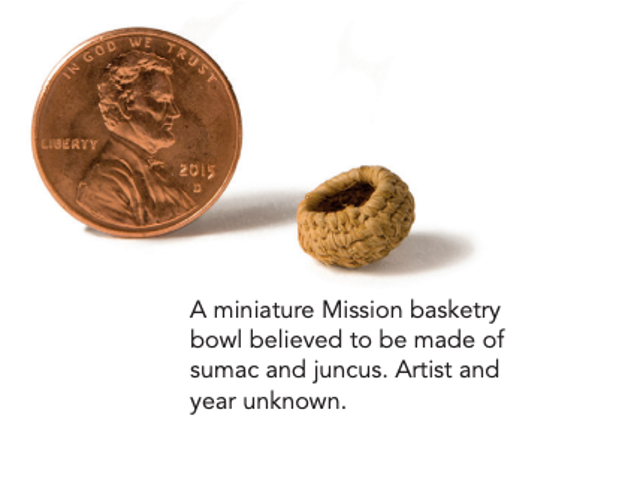
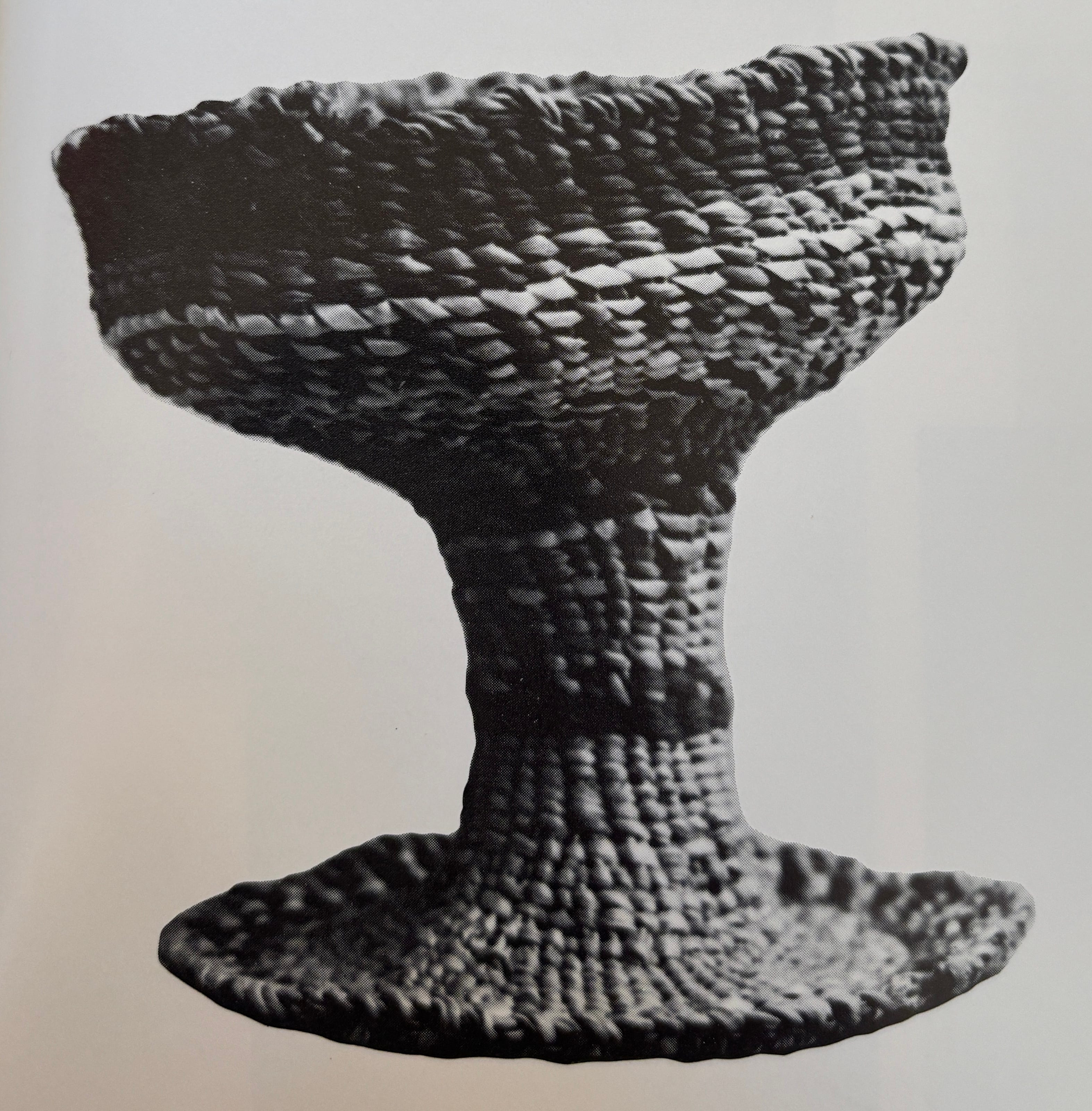
Stylistically, there are no cohesive “Mission” patterns according to Chavez and basketry expert Chris Moser— a stark contrast to Kroeber’s assertion that “Mission” baskets could be treated as a unit without considering tribal affiliation (1922: 153). Basketry styles were as diverse as the tribes represented and the individual skill and preference of the weaver. Since tribal groups shared some motifs and designs, and weavers themselves were often affiliated with multiple tribes (i.e., parents/relatives from different/multiple tribal backgrounds), it can be difficult to parse out tribal attributions without records. Primary classes of design elements include geometric motifs, plant motifs, land creatures, birds, and environmental motifs. Non-traditional motifs include words, domesticated animals, mission bells, and arrowheads (Moser 1993: 29). Moser warns that basketry designs can be easily misinterpreted by outsiders— some design elements were created simply to break up the monotonous process of weaving (1993: 29). While some designs can tell stories and convey meanings, others may be purely decorative and unrelated to social practices and worldviews (Moser 1993). On the other hand, nontraditional elements incorporated into basketry by weavers may also have been misunderstood— Moser suggests that weavers may have been employing European and American designs purely for aesthetics (1993). The perspectives of both Moser and Chavez provide valuable context and reflexivity for interpreting basketry construction and designs today.14
In Native American Basketry of Southern California, Moser (1993) explains how manufacture, rather than style, unites “Mission” basketry. Ipai weaver and author Justin Farmer contributes technical and cultural knowledge to reassess the “Mission” designation. All “Mission” baskets coil in a clockwise direction from the working surface— the side of the object intended to be viewed. The working surface of a bowl-shaped vessel will be the outer walls, while the working surface of a tray is the “inner” or the open, flat surface. Weavers also employed the same method of refining coiled stitching with the “Mission stitch”. Every sewing strand (weft element) has a beginning or “fag” end, and when the strand is sewn through the coil, a small ½ inch end of the sewing strand is left out. Before the following stitch is pulled through, the loose end is tucked into that stitch to conceal it. The result of the “Mission stitch” is seamless basketry construction which would have been appealing to weavers and basketry collectors alike. Chavez interprets the Southern California style of coiled basketry as representing a regional pattern rather than a style created by or representing Spanish Missions. Chavez (2012: 55) argues that Chumash baskets represent the only true “Mission” style as defined by Kroeber, since these baskets incorporate Spanish heraldic motifs directly influenced by Franciscans.
For Native SoCal weavers post-1890, there was a trend towards pictorial designs such as animals, insects, and arrowheads, likely due to collectors’ preference— a selective process that impacted design choices as well as the representative samples present in basketry collections today (Moser 1993: 115). Information on Native basketry manufacture and design prior to European contact is limited to archaeological evidence, historical and museum collections, indigenous memory, and oral histories. 19th and 20th century basketry traditions reflect, but do not wholly represent, pre-contact basketry; instead, they reflect the material and cultural world of a weaver at the time they were created. Cultural exchange between different tribal groups, and between Native Californians and Euro-Americans, influenced the materials, construction, use, and design elements of Native basketry creating the unique basketry traditions we have today.
Conclusion (slightly tangential)
During the “basket craze”, describing Native baskets as “Mission-style” fed into Euro-American fantasies of the Mission era. Today, the term is still used to describes baskets made during the late 19th and early 20th century. Museums do not often display contextual data on baskets— they may be exhibited alongside archaeological arrowheads and tools to represent pre-contact material culture even though the basket was woven in the 20th century for a private collector. Similarly, as baskets are accessioned with only the “Mission” label, the true cultural affiliation and historical context of the object is lost. My museum studies hot-take is this: provenance/provenience should be displayed for the public. Whether a collection was privately collected, looted, salvaged, etc. is valuable context that aids in our understandings of both material culture and the process of these materials winding up in museums.15 It is important to disentangle these labels and separate archaeological from ethnographic materials and give these objects, and their creators, the contextualization they deserve. But I digress…
I hope you learned a bit more about basketry and the value of indigenizing California mission art, I know I learned so much from Chavez’s work myself. We cannot only focus on the cultural devastation of the Mission era— narratives of destruction feed into the myth that Native peoples did not survive colonization and leads to their cultural contributions being overlooked. As we know, Native peoples actively preserved their culture despite oppressive conditions, and the mission era is just one chapter in the living story of California’s Native peoples.
I am embarrassed to reflect on how long it has been since I’ve put pen to paper for this publication. It’s not for lack of trying, I’ve had to redirect my creative energy elsewhere— towards finishing my Master’s thesis, presenting at conferences, and getting through the last semester amidst global turmoil. I know national/international politics may not seem relevant to this publication, but I am deeply affected by tragedies in my community and beyond (some of which have allegedly been committed on my behalf). Since Substack is an international platform and I have subscribers from all over the world, I wish you all safety and peace. I hope this post finds you well, or can at least distract you through a peace-less time. Thank you <3
Repatriation in this context means the return of Native American cultural items from a federal institution (museum) to a federally recognized tribe(s).
Seagrass cordage from Daisy Cave on San Miguel Island!!!
Connolly, Thomas J., Jon M. Erlandson, and Susan E. Norris. “Early Holocene Basketry and Cordage from Daisy Cave San Miguel Island, California.” American Antiquity 60, no. 2 (1995): 309–18. https://doi.org/10.2307/282142.
However, San Junipero Serra established 8 of the 21 missions, not all of them.
Chavez, Yve. 2025. “Gabrieliño Architecture and Reclaimation” from Indigenizing California Mission Art and Architecture. pg. 103-125. University of Washington Press.
This is based on personal evidence and conversations I’ve had— if you feel differently or think I’ve mischaracterized this sentiment, please let me know.
Cook, S.F. 1976. The Conflict between the California Indian and White Civilization. Berkeley: Universty of California Press.
Toypurina, an influential medicine woman from a village nearby San Gabriel Mission aided in the rebellion and was put on trial. She was baptized and exiled to another mission where she was married to a Spanish soldier. This event is discussed in Chavez 2025: 131-135.
Schneider, Tsim D., Khal Schneider, and Lee Panich. 2020. “Scaling Invisible Walls: Reasserting Indigenous Persistence in Mission-Era California.” The Public Historian 42 (4): 97–120.
Panich, Lee. 2013. “Archaeologies of Persistence: Reconsidering the Legacies of Colonialism in Native North America.” American Antiquity 78 (1): 105–122.
Chavez, Yve. 2025. Indigenizing California Mission Art and Architecture. University of Washington Press.
Ahlqvist, Laura, and Bryn Barabas Potter. 2023. “‘Just a Souvenir?’ Entangled Identities within an Early 20th Century American Indian Basket Collection.” Journal of Material Culture 28 (3): 479–98. https://doi.org/10.1177/13591835221149685.
Smith-Ferri, Sherrie. 1998. “Weaving a Tradition: Pomo Indian Baskets From 1850 Through 1996.” University of Washington.
Chavez, Yve. 2012. “Indigenizing Southern California Indian Basket Studies: Unpacking Issues of ‘Mission’ and ‘Tradition.’” PhD diss., University of Washington.
Chavez, Yve. 2019. “Basket Weaving in Coastal Southern California: A Social History of Survivance.” Arts 8 (3): 94. https://doi.org/10.3390/arts8030094.
Kroeber, Alfred. 1922. Basket Designs of the Mission Indians of California. American Museum of Natural History.
American Museum of Natural History, British Museum, Museum of the American Indian, and University of California Museum of Anthropology.
Moser, Christopher. 1993. Native American Basketry of Southern California. Riverside Museum Press.
The Yosemite museum has a great exhibit which includes weavers’ names and the basket donors (often the weaver herself). Of course provenance information is not always known which makes this contextualization difficult. Side note: my pet-peeve is seeing imported archaeological materials with “no date” or “no affiliation” at LACMA or Getty which usually means they were looted. Like if you’re going to display looted materials might as well stand on business and say it. But, art dealers trading and exporting looted materials from Mexico/Latin America was a HUGE thing in LA in the 20th century (e.g. Stendahl gallery)… I digress…